Spray Foam Insulation in Toronto, ON
We use spray foam where nothing else will do the job. When blown-in does the same work for less, we'll say so.
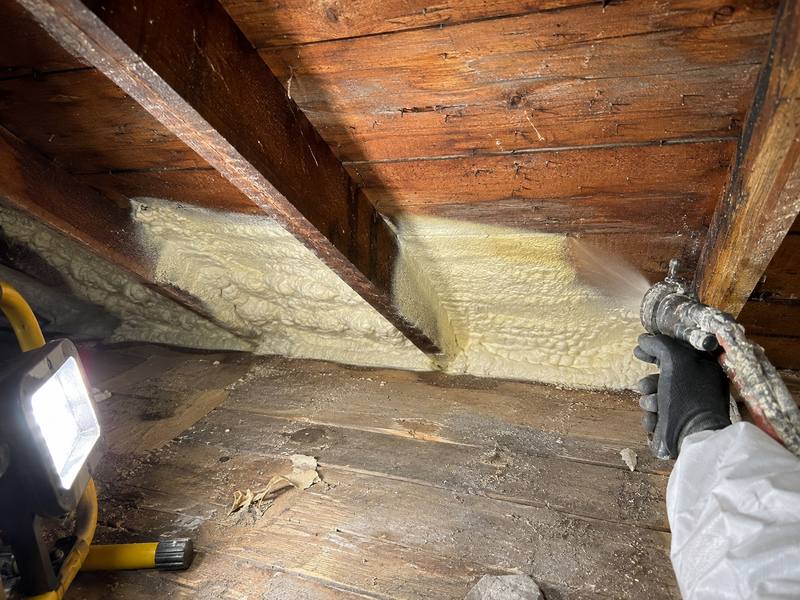
For Toronto homeowners looking at spray foam insulation, the spots that suit it are rim joists, sloped ceilings, knee walls and the gaps around pipes and wires. Spray foam seals and insulates in one pass, which is why it's the right choice there. An open attic floor is different. Foam works there but costs more, and blown-in insulation covers that floor well for less. We'll tell you which kind of space your house has.
Where spray foam insulation earns its cost
Spray foam earns its cost in spaces where air leaks meet a cold surface and the space is too tight or uneven for batts or loose fill. The foam expands into cracks and sticks to wood and masonry. Once it cures, it is the air barrier and the insulation at the same time. In older houses, four spots suit it well.
Rim joists in the basement
The rim joist is the band of framing that sits on top of the foundation wall. In most Toronto basements it's bare wood with thin gaps behind it, so cold air comes in all the way around the perimeter and the floor above feels cold at the edges. We spray closed-cell foam into each joist bay, which seals the gaps and insulates the wood in one visit. Fibreglass stuffed into the same bay doesn't do either job well.
Sloped and cathedral ceilings
Sloped ceilings in half-storey bedrooms and cathedral ceilings in additions have no attic above them. All you have is the rafter bay between the plaster or drywall and the roof boards. Foam fills that bay tight to the wood. Warm, moist air from inside can't get through to the cold roof deck and condense on it.
Knee walls and attic kneewall spaces
In a storey-and-a-half house, knee walls are the short walls between a finished room and the low attic space behind it. The attic side is often left open, so the batts sag or fall out and air moves around them freely. We foam the back of the knee wall and the joist bays that run under it. With that path closed, those rooms stop being cold in January and hot in July.
Gaps around penetrations
Every plumbing stack, wire and duct that runs through a ceiling or a rim joist leaves a gap around it. We fill those gaps with low-expansion foam before any insulation goes on top. That's the main part of air sealing, and on a lot of jobs it's the only foam the house needs.
Where blown-in insulation is the better call
If the attic floor is open and has room for depth, blown-in insulation is usually the better choice. Loose cellulose or fibreglass blown over the ceiling joists settles in around wires and bracing and builds up to full depth for far less money. Once the leaks underneath are sealed, foam on that same floor costs more and does the same job.
That's spray foam vs blown-in in short. Foam goes in spaces that are tight, sloped or leaky in ways loose fill can't reach. Blown-in attic insulation goes where the attic is open and deep. Many attic insulation jobs end up using a bit of both.
- Foam is worth it: rim joists, sloped and cathedral ceilings, the attic side of knee walls, and small gaps around pipes, wires and ducts.
- Blown-in does the same job for less: an open attic floor with clear headroom, including one that just needs a top-up over the old insulation.
- Blown-in does the same job for less: closed wall cavities, where we blow dense-pack insulation in through small holes in the plaster.
- Decided on site: a low attic where we can only reach part of the floor. Sometimes that means foam at the edges and blown-in across the middle.
Open-cell or closed-cell spray foam
Closed-cell foam is dense and rigid, and it slows vapour. Open-cell foam is soft and light, and vapour passes through it. In a Toronto house, the choice comes down to whether that spot needs a vapour retarder built into the foam.
Closed-cell spray foam
Closed-cell spray foam cures hard, with its cells sealed shut. It blocks air, and at full depth it slows vapour enough to work as the vapour retarder. It also fits more insulation into a thin layer, which matters when the rafter bay is shallow. We use it on rim joists, against foundation walls, and in sloped ceilings where there's no room for a separate membrane.
Open-cell spray foam
Open-cell spray foam has open cells and a spongy feel. It stops air, but vapour gets through. Through a Toronto winter that means it needs a separate vapour retarder on the warm side, or indoor moisture can reach cold wood. Open-cell costs less for the space it fills and it dampens sound, so it suits deep, uneven cavities that can take a membrane over the top.
Spray foam on sloped ceilings without an attic
For new houses in Zone 1, SB-12 sets a minimum nominal R-31 for a ceiling without attic space. That rule applies to new construction, but it gives you a sense of how much a roof-line ceiling is expected to hold when there's no attic for loose fill.
Older Toronto homes rarely have that much room. In an older half-storey the rafters are often shallow, and the bay between the plaster and the roof boards is all the space you get. Closed-cell foam puts the most insulation into that depth and seals the bay at the same time. This is where spray foam attic insulation makes sense: under the roof line, not across the floor.
If a sloped ceiling is being opened up for other work anyway, we can foam the rafter bays from inside. If the ceiling is staying closed, we look first at the flat part of the attic above it.
Why some people remove spray foam
People remove spray foam because it went in badly. The material itself usually isn't the problem. Foam sprayed onto damp or dusty wood can pull away from the framing and leave gaps behind it. Foam mixed in the wrong proportions can leave a smell in the house that never clears. And foam sprayed tight to the underside of the roof boards can hide a leak until the wood has gone soft.
Our crew can take out spray foam that has pulled away, smells, or is hiding wet wood. With it off, we check the boards and framing before anything new goes in.
Most of this never happens if the surfaces are dry and clean, the space is ventilated while the foam sprays and cures, and the crew can explain what they're using. Before anyone sprays foam in your house, ask them:
- Open-cell or closed-cell, and why that type for this spot.
- How thick it will go on, and what that thickness does for the space.
- What prep happens first: old insulation out, wood dried, and the rest of the house sealed off from the work area.
- How the space is ventilated while the foam sprays and cures, and when your family can go back in.
- If the foam goes against the roof boards, how anyone would find a leak later.
What decides spray foam cost
Spray foam cost comes down to four things: the type of foam, how thick it goes on, how easy the space is to get to, and what has to come out before we spray.
- Type: closed-cell costs more than open-cell over the same area because the material is denser.
- Thickness: each extra layer takes more material, and closed-cell goes on in several passes.
- Access: a basement rim joist with clear headroom goes faster than a knee wall you have to crawl to, or a sloped ceiling that has to be opened.
- Prep and removal: old batts, rodent nests and wet insulation come out first, and that time is part of the job.
Rebates and permits for spray foam work
Home Renovation Savings rebates that require a home energy assessment cover insulation for attics, walls, foundations and exposed floors, and spray foam work often falls into one of those. Because the rebate depends on that assessment, plan for it before any foam goes in. Our attic insulation rebates page walks through the process, and the attic insulation cost page shows how foam compares with blown-in.
The City of Toronto lists adding or replacing insulation as work that doesn't need a building permit. If the job also opens walls or ceilings for other changes, check that part with the city separately.
FAQ
Common questions about spray foam insulation
People remove spray foam because it was installed badly, usually because it pulled away from the framing or smells from poor mixing. The other common reason is foam sprayed against the roof boards, which can hide a leak until the wood rots. Dry surfaces, good ventilation during the install and a crew that can explain the product prevent most of this.
Yes. Spray foam costs more than blown-in insulation over the same area, and closed-cell costs more than open-cell. It's worth paying for in tight spots like rim joists, sloped ceilings and knee walls, where nothing else seals and insulates in one pass. On an open attic floor it usually costs more for the same result.
Closed-cell foam is dense and rigid and slows vapour. Open-cell foam is soft and light, and vapour passes through it. Both stop air. In a Toronto house, closed-cell suits rim joists and shallow sloped ceilings, and open-cell needs a separate vapour retarder on the warm side.
Not for an open attic floor. Blown-in insulation does the same job there for less money. Spray foam is the better choice under the roof line: sloped ceilings, knee walls and attics with no floor space for loose fill. In most attics we seal the gaps first, then blow in the full depth.

Next step
Book an attic insulation inspection in Toronto
Call us, or send the form with your address and whatever you've noticed upstairs. We'll look at the attic, tell you which of the four outcomes fits, and put the work in a written quote.